
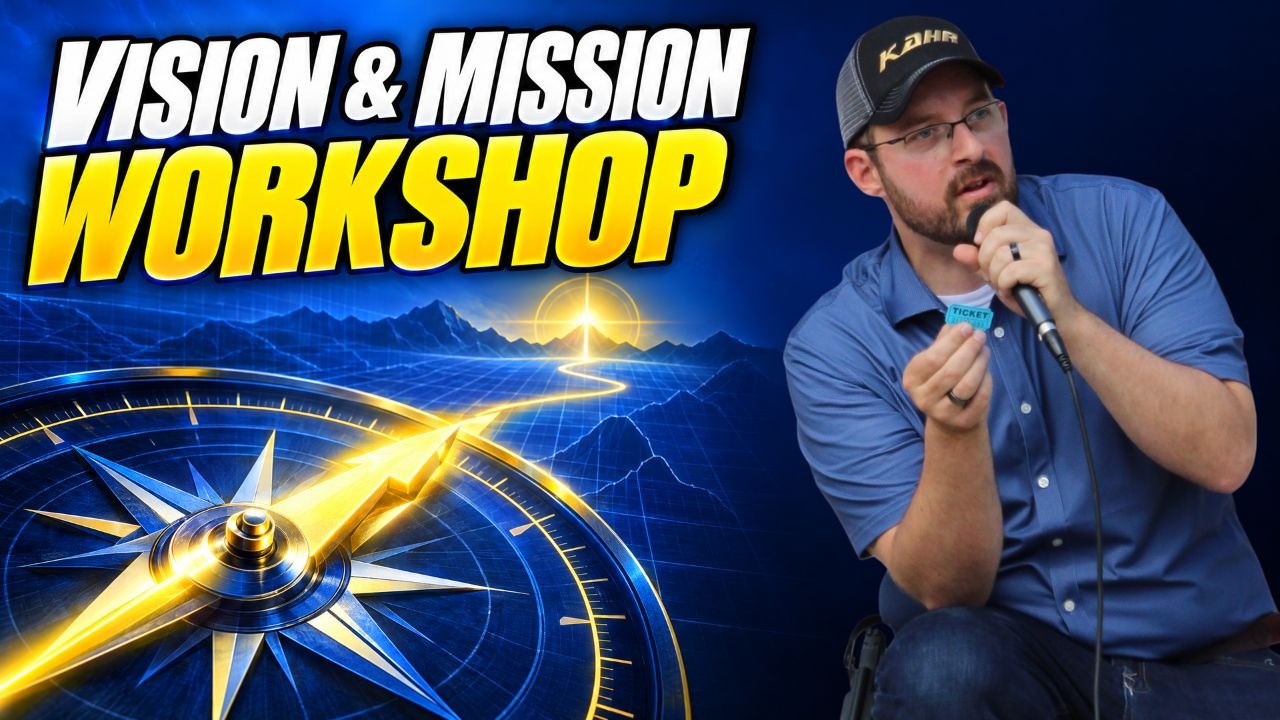



A strong firearm business needs more than good instruction, a quality facility, or a great product. It needs a clear picture of what success looks like and a repeatable set of behaviors that move the business toward that picture.
In this coaching call, Andy Hallinan breaks down the difference between vision and mission for firearm instructors, shooting ranges, and gun stores. The workshop turns those ideas into a practical framework, define a measurable future, identify the behaviors that support it, measure the current results, and focus on the constraint that is slowing the business down.
Important: The examples, figures, and business results below were discussed during the coaching call. They are not promises or guarantees. Use the framework as a planning exercise, then evaluate your own numbers, resources, market, and operating capacity.
Vision Is a Measurable Future Picture
The workshop defines vision as a clear, measurable picture of the future of your business that every system works together to make real. For a firearm instructor, shooting range, or gun store, that means success cannot remain a vague idea such as growing, helping people, or becoming more profitable.
A useful vision should let you answer three questions: What will the business achieve? How much or how many will it achieve? By what date will it happen? When the answer is clear, employees, vendors, instructors, customers, and other partners can understand what the business is working toward.
Mission Is the Behaviors You Repeat
If vision is the picture, mission is how you get there. The mission is the core set of behaviors your business needs to repeat every day, every week, every month, or every year in order to make the vision real.
The coaching call emphasized the words behaviors and repeat. Businesses are built through systems, and systems only help when they point in the same direction. Trying a different tactic every day can feel productive, but it makes it difficult to know what is working. Repeating the right behavior gives you the opportunity to improve it and measure its effect.
Recognize the Burn Before It Runs Your Business
The workshop used the term “the burn” to describe the period when a business owner feels stuck, frustrated, overwhelmed, and financially strained. The symptoms can include posting content without signups, launching new offers before the last one has had time to improve, buying another tool for relief, or feeling that every task is urgent.
When a business is in the burn, a new idea can look like an escape. The owner may launch another class, redesign a flyer, or change direction before learning whether the previous behavior could have worked with better execution. The workshop’s answer is to return to a measurable future picture and stay focused on the repeatable behaviors that move the numbers.
Build Your Vision with What, How Much, and By When
The call offered a simple template for writing a vision statement: achieve what, measured by how much or how many, by a specific date.
- What is the specific future state you want to create?
- How will you measure the result, through revenue, profit, impact, students, members, or another meaningful number?
- When will you achieve it? Choose a realistic deadline that creates urgency without turning the vision into an impossible wish.
The vision should be short enough to remember and repeat. If your team cannot say what the business is working toward, the vision is not yet doing its job.
Measure Revenue, Profit, and Impact Together
The coaching call identified three useful categories for measuring a business vision, revenue, profit, and impact. Revenue shows what the business generates. Profit shows what remains after expenses and helps sustain the owner and the operation. Impact shows the difference the business is making for students, members, customers, and the broader community.
These measures support one another. Revenue creates the possibility of profit, profit gives the business resources to continue, and impact supports the reputation and value that can create future revenue. Serving a community without a sustainable business model can eventually lead to burnout, because the owner has to divert time and energy elsewhere to pay the bills.
Start with the Numbers You Have Today
Once you define the future, you need a baseline. The speaker described realizing that Warrior Marketing Group needed a clearer way to measure its impact, then building a live tool at joinwmg.com to track the students trained and revenue generated by connected businesses.
The workshop stated that, as of October 9, 2026, businesses associated with Warrior Marketing Group and using its software had trained 11,608 students and generated $2.1 million in revenue since November 2024. Those figures were presented as the program’s own reported measurements during the call, not as an independent audit or a promise of future results.
The takeaway for any firearm business is simple, measure your current position before trying to improve it. Track the number of students trained, revenue, profit, returning students, class attendance, members, and any other number that directly connects to your vision.
Find the Constraint That Is Holding You Back
A business cannot improve every problem at once. The call encouraged owners to identify the current constraint and direct their attention there.
- If too few people see the offer, the constraint may be marketing or reach.
- If people visit the website or view the offer but do not sign up, the offer or the sales process may need attention.
- If students do not finish or return for additional training, the return-student experience may be the constraint.
- If the business trains many people but cannot keep enough profit, profitability may be the constraint.
- If classroom capacity or access to a facility is full, capacity may have become the next constraint.
The goal is not to solve a future problem before it exists. Use the space, schedule, and systems you have now, then address capacity when it becomes the number that limits growth.
Track Student Return and Membership Conversion
The workshop highlighted repeat business as a key measurement. The speaker cited a common pattern in which many students do not return for a second class, then compared the timing to eating a meal. A student may enjoy the first class but not be ready to buy another experience immediately after it ends.
To establish a baseline, review the last 12 months and calculate the percentage of first-time students who returned for additional training: returning students divided by first-time students, multiplied by 100. Track that percentage each month and improve the behavior that helps students come back.
For a shooting range, a similar calculation can measure membership conversion: new members divided by non-members who used the range, multiplied by 100. The exact numbers will vary by business, but the important step is turning an invisible problem into a measurable result.
Turn the Vision into Repeatable Behaviors
Once you know the target and the baseline, work backward. Ask what must happen each year, month, week, and day to reach the result. The mission is the set of behaviors that connect the current number to the future number.
The mission Andy shared for Warrior Marketing Group was to help firearm instructors, shooting ranges, and gun stores grow faster by applying proven business principles, simplifying execution through software, and continuously improving results through data. In the workshop, that mission was presented as the repeated process used to pursue the larger vision of empowering firearm entrepreneurs to train 1 million new gun owners by 2030.
Use a New Shooter Accelerator as a Business Example
The New Shooter Accelerator was presented as one example of a system designed to address two business problems, filling seats and encouraging students to return for more training. The model described in the call is built around a host creating an experience, rather than an instructor simply delivering a class, followed by an invitation to continue into a larger training package.
The workshop described the offer as a package of multiple classes, often six, seven, or eight, with an invitation price of about $997 or $1,000. The purpose of the example was to show how an instructor can create a repeatable student journey, not to suggest that every business should use the same price or structure.
The three operating steps described were:
- Pack the house, filling the available seats.
- Give students a strong experience led by a host.
- Make a clear invitation to the next appropriate training experience.
Let the Math Show You the Required Pace
The call demonstrated a planning tool using an illustrative scenario, 30 seats in a class, a goal of $200,000 in annual revenue, a $997 invitation, and a target invitation acceptance rate. In that example, the tool calculated a pace of roughly one class every three weeks, 600 students through the door each year, 180 accepted invitations, and approximately $33 per day in Facebook advertising.
The speaker specifically noted that the tool is not a promise or guarantee. Its value is that it helps an owner connect a desired result to the behaviors and inputs required to pursue it, such as class frequency, attendance, invitation acceptance, and cost per acquisition.
Cost per acquisition is the amount spent to generate a signup. If your advertising cannot be tracked, you may not know whether the behavior is moving you toward the vision. Track the actual number, then compare it with your margin and capacity before increasing spend.
Build Capacity Before You Are Ready to Launch
One question came from an instructor who was not yet ready to launch because of a health issue and other business tasks. The coaching call’s advice was to build capacity while the current constraint is being resolved.
That capacity can include a list of people connected to the Second Amendment community, email contacts, text-message contacts, referral relationships, content, and a basic spreadsheet. The point was to collect contact information directly rather than handing someone a business card and hoping they follow up later. Building the list now can make the eventual launch more productive when the business is ready to operate.
Examples Shared by Firearm Business Owners
The call included testimonials from coaching participants. Josh, owner of High Caliber Training Center in Illinois, said his education revenue had grown from roughly $10,000 to $12,000 per month to more than $40,000 in each of the three months before the call, and that the business had added more than half a million dollars to top-line revenue during the year. These were his statements during the call, not independently verified results.
Shawnee Hart of Tri-Defense Academy described starting from a basement classroom, using advertising and a structured training program, and reaching approximately $160,000 in income for the year with 91 VIP training members, according to her comments during the call. She also said the business was moving into a new space because demand had grown.
The examples support the central lesson, a vision gives the business a destination, but the repeated behaviors, measurement, offer, follow-up, and operational capacity are what create the path.
Your Vision and Mission Worksheet
Use the following questions to turn the workshop into a working plan for your own business:
- What specific future result will your business achieve?
- What number will prove that you achieved it?
- What date will you use as the deadline?
- How many students, members, or customers must you serve to reach that number?
- What percentage of students return for another experience?
- What is your current cost per acquisition?
- What is the biggest constraint right now, marketing, offer, returning students, profit, or capacity?
- What behaviors will you repeat, and how often will you repeat them?
- What will you measure each week or month to know whether you are on track?
Write the answers in language your team can remember. Your vision should describe the destination, and your mission should describe the behaviors that repeatedly move the business toward it.
Watch the Vision and Mission Workshop
Watch the full coaching call above for the complete workshop on measurable vision, repeatable mission behaviors, business constraints, student return rates, cost per acquisition, capacity planning, and the systems that help firearm businesses move from uncertainty to intentional execution.






Leave a Reply