
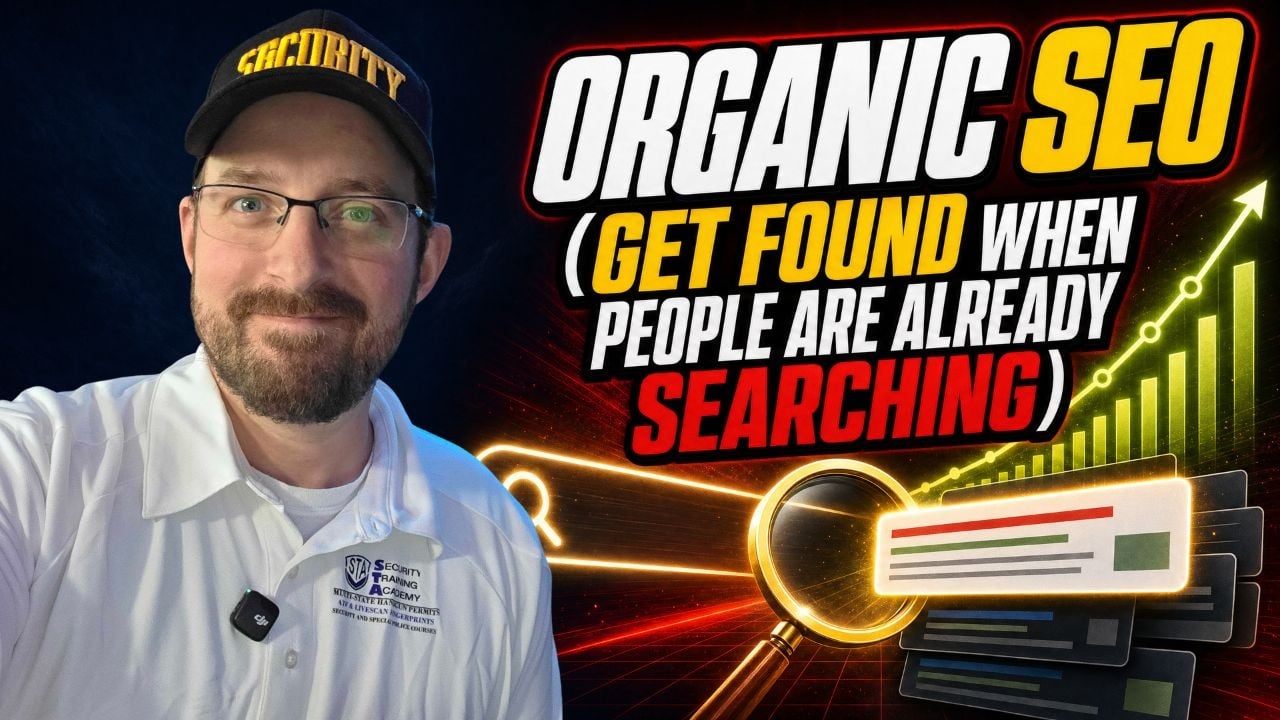



Paid advertising can create demand quickly, but organic search helps a business get discovered when people are already looking for an answer. The two channels serve different purposes, and understanding that difference prevents business owners from expecting slow SEO to deliver the immediate return of a paid campaign.
In this coaching call, the team explains how to approach organic SEO without getting trapped in vanity metrics, low-quality content, or endless technical tools. The focus is on earning trust, publishing useful material, and building a repeatable system that turns real conversations and customer experiences into search-friendly content.
Paid Ads Create Speed, Organic SEO Captures Demand
The recommendation is to launch paid Facebook advertising before investing heavily in organic SEO. Paid ads create speed. They interrupt people in a social environment, introduce an offer, and let a business test messaging and generate leads while the longer-term organic strategy is being built.
Organic SEO works differently. It does not create demand from nothing. Instead, it positions a business to respond when existing demand leads someone to Google. A person searching for firearm instructor marketing, SEO for a shooting range, or a way to advertise firearms without Facebook is already telling you what problem they want solved.
Paid ads can help create new demand and provide immediate feedback. Organic search helps capture demand that already exists. A strong marketing system can use both, but business owners should understand the different timelines before deciding where to put their effort.
Use Search Console Instead of Chasing Vanity Metrics
SEO produces a large amount of data, but not every number deserves attention. The call used an Aura Ring analogy: tracking health metrics can be interesting, but the information has no value if it does not lead to a change in daily behavior. SEO data should be treated the same way.
Google Search Console is the preferred starting point because it provides direct information about how Google sees a website. The key metrics are clicks, impressions, click-through rate, and average position. These numbers can reveal which searches are creating visibility, which pages are earning attention, and where a better headline or description could improve results.
Ignore metrics that do not change a decision. The goal is not to collect a bigger dashboard. The goal is to use reliable information to decide what to publish, what to improve, and what to stop doing.
What Google Actually Rewards
Google makes money by keeping users on its platform and giving them results they trust. That is why shortcuts do not create durable rankings. A site has to earn visibility by proving that it can answer a question better than the alternatives.
That does not mean every page must be perfect. It does mean the content should be useful to a real person, the website should be easy to navigate, and the business should have genuine experience behind what it publishes. Ranking is a byproduct of usefulness and trust, not a reward for stuffing a page with keywords.
The Three Key SEO Levers
1. Content Quality
The first SEO lever is content quality. Write for human engagement first and search engines second. Generic articles produced from a shallow prompt often sound interchangeable, and Google has become increasingly good at recognizing content that does not provide original value.
The strongest material comes from the business itself. A live coaching call, an active class, a customer question, a campaign review, or a hard lesson from the field can all become valuable content because they contain details that a competitor cannot simply copy.
Use the language customers actually use. Explain what happened, what worked, what failed, and what someone else can learn from it. Authentic experience makes content more credible and gives search engines a reason to rank it.
2. Incoming Links and Domain Authority
The second lever is incoming links, often discussed as domain authority. When a credible external website links to your article, it functions like a reputational vote. A link from a respected news publication or industry resource can carry more weight than a collection of low-quality directory links.
The call challenged the old idea of creating isolated partner pages and waiting for traffic. A better approach is to publish comprehensive articles that are genuinely useful to other businesses in the network. Members can then reference one another’s work through relevant, natural link exchanges and community discussions.
The link should make sense for the reader. The goal is not to manufacture a pile of links. The goal is to create resources that other people want to cite because the resources are clear, specific, and useful.
3. On-Site Engagement
The third lever is on-site engagement. A high bounce rate can indicate that a page is not answering the visitor’s question or that the next step is unclear. Keeping bounce rate under 80% is a reasonable foundation, but the larger point is to create a clean path through the site.
Visitors should be able to understand what the business does, find the relevant information, and see a clear call to action without fighting through clutter. Navigation, page speed, useful internal structure, and a relevant next step all help turn search visibility into a business opportunity.
WordPress was recommended because it gives the business more control over content, structure, and publishing. That control is valuable when organic search is a serious part of the growth plan.
Turn Coaching Calls Into an SEO Content System
The most practical part of the call was the content-repurposing workflow. It begins with a real source of experience, such as a one-hour coaching call, a class recording, or regular footage from active instruction.
- Record a live call, class, or conversation that contains useful customer and business lessons.
- Transcribe the recording so the original ideas and language are preserved.
- Provide the transcript, video URL, and thumbnail to an AI assistant that can organize the material into a complete article.
- Format the article in WordPress, embed the video, add the featured image, and place relevant conversion opportunities around the content.
- Broadcast the finished article to the community email list so the content earns attention, engagement, and potential links.
This process turns one hour of real work into a durable library of articles, videos, and follow-up opportunities. It is not a replacement for expertise. It is a way to make sure the expertise gets published consistently.
Let Keywords Tell You What to Publish Next
Keyword tracking should determine what gets created next. Search Console can show whether terms such as firearm instructor marketing, how to advertise firearms without Facebook, and SEO for shooting ranges are gaining impressions and clicks.
When a keyword begins to move upward, that trend can guide future articles, videos, and email topics. The goal is to build a connected body of work around the questions the audience is already asking. Over time, consistent publishing can create meaningful visibility without relying on one lucky article.
Domain, Redirect, and Platform Lessons
The question-and-answer portion covered several common problems. One attendee saw search rankings fall after moving to a temporary “join me” placeholder site. The recommendation was to undo a misconfigured redirect and restore the correct primary domain. A placeholder can satisfy a technical requirement, but it is not a substitute for a real content system.
Another discussion focused on rebuilding an old website. A cosmetic redesign alone does not create new sales. Before spending time on colors, layouts, and surface-level changes, the business should build a repeatable content process and use paid advertising to generate measurable demand.
The call also warned against relying on a built-in blogging module that does not provide enough control. A separate WordPress installation gives the business a more flexible home for articles, videos, categories, metadata, and search-focused publishing.
The Real Organic SEO Advantage
Organic SEO is a long game, but it does not have to be a vague game. Use paid advertising for speed, use search to capture existing demand, and measure the signals that lead to clear decisions.
Publish from real experience, earn relevant incoming links, improve the visitor journey, and turn every useful coaching conversation into a durable content asset. The businesses that win organic search are usually the ones that keep showing up with something genuinely helpful.
Get armed, get trained, carry daily. Long live the Republic.








Leave a Reply