



Most website landing pages don’t fail because of bad design, slow load times, or weak traffic.
They fail because they don’t lead.
If your landing page looks “professional” but doesn’t consistently convert visitors into leads, students, or buyers, the issue isn’t technical—it’s structural. You’re explaining what you do instead of showing people who they become.
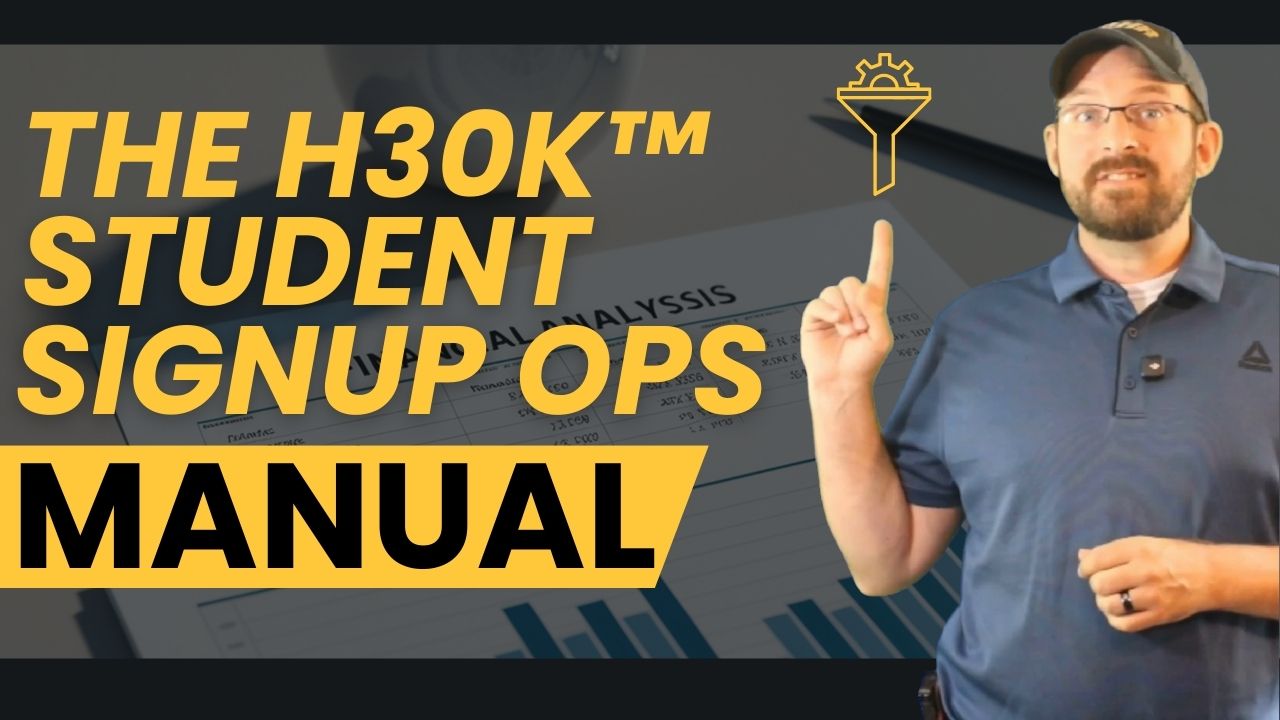
That’s exactly why the H30K™ Student Signup Ops Manual exists.
This post breaks down how an ops manual approach—built on the H30K™ Method—creates landing pages that convert by design, not by guesswork.
Why Most Landing Pages Underperform
Here’s the hard truth:
Most landing pages are built backwards.
They start with:
Features
Credentials
Certifications
Long explanations
And generic calls to action
But people don’t buy clarity.
They buy confidence.
And confidence comes from structure.
The Real Problem
Landing pages fail when they:
Increase fear instead of reducing it
List features instead of outcomes
Assume trust instead of building it
If your page is trying to “convince,” you’ve already lost.
The Ops Manual Mindset (This Is the Shift)
An ops manual doesn’t decorate.
It directs.
Instead of asking:
“What should this page say?”
You ask:
“What does this visitor need to feel, understand, and believe—in order—to take action?”
That’s the difference between a webpage and a conversion system.
The H30K™ Structure for High-Converting Landing Pages
Every high-performing landing page follows the same transformation sequence. This comes directly from the H30K™ Method.
1. Give Them an Experience (Immediately)
Your headline and opening section should make the visitor feel:
Understood
Seen
Relieved
Example:
Instead of “Sign Up for Firearm Training,”
you communicate:
“Walk in nervous. Walk out confident.”
Action Step:
Rewrite your headline so it describes the emotional before-and-after, not the offer.
2. Give Them Meaning
People need to know why this matters—beyond the transaction.
Meaning answers:
Why this decision is important right now
Why staying the same is the real risk
Example:
You’re not selling a class.
You’re selling readiness, confidence, and responsibility.
Action Step:
Add a short section that reframes the visitor’s problem as something bigger than logistics.
3. Give Them a Transformation
People don’t want more information.
They want a new identity.
Your page should clearly answer:
Who are they now?
Who do they become after this?
Example:
From: “First-time student”
To: “Confident, capable, prepared individual”
Action Step:
Add a clear transformation statement:
“This is who this is for—and who it’s not for.”
4. Give Them a Journey
Confusion kills conversions.
Your page must show:
What happens first
What happens next
What happens after
Not details—direction.
Example:
Download the manual
Apply the structure
Build pages that convert consistently
Action Step:
Add a simple 3-step flow that removes uncertainty.
5. Give Them an Invitation (Not a Push)
High-performing landing pages don’t pressure.
They invite.
Your CTA should feel like the next logical step, not a sales pitch.
Example:
Instead of “Submit,”
use:
“Send Me the Ops Manual”
Action Step:
Rewrite your CTA to sound like permission, not pressure.
Why an Ops Manual Beats Templates Every Time
Templates assume your business is generic.
An ops manual assumes your business:
Has a mission
Has a message
Has a responsibility to lead
That’s why the H30K™ Student Signup Ops Manual isn’t:
A copy-and-paste template
A design guide
A marketing theory lesson
It’s a decision-making framework for building pages that reduce fear, build trust, and guide action.
What Changes When You Apply This System
After applying the ops manual approach, you’ll know:
Exactly what to say above the fold
Exactly what to show before asking for commitment
Exactly where to place trust builders, proof, and CTAs
Most importantly—you stop guessing.
Final Thought
Your landing page is not a brochure.
It’s a leader.
If it doesn’t guide, calm, and confidently move people forward, it’s costing you opportunities every day.
Structure wins.
Clarity converts.
And systems scale.
Your Next Step
Open your current landing page and ask one question:
“Does this page lead—or does it explain?”
Then rebuild it using the H30K™ structure.
That’s how you build landing pages that actually work.


Leave a Reply