The Simple Copywriting Formula I Use to Build Every Funnel
When your offer is already dialed in and irresistible, your next job is to communicate it in a way that grabs attention, sparks emotion, and pushes people to take action. That’s where the What / Who / When Framework comes in.
This is the exact framework I use on every landing page, ad, email, and video script. It keeps your messaging tight, persuasive, and emotionally charged – without guessing, overthinking, or writing pages of fluff.
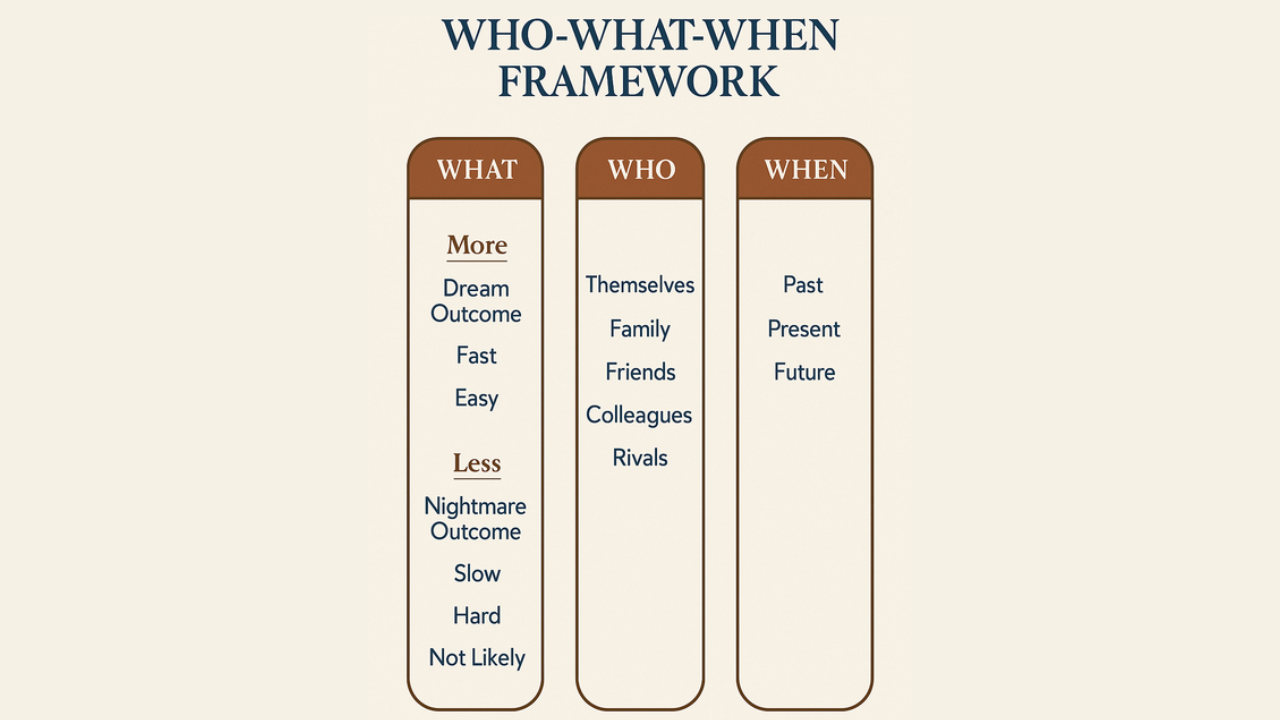
Here’s what was on the whiteboard at the end of the coaching call:
Part 1: The What
What to say more of – and what to say less of.
This is where most firearm instructors fail. They talk about logistics, features, class dates, round counts – instead of speaking to the things that actually move people emotionally.
The “What” section tells you exactly what to increase in your copy and what to decrease.
MORE of the Dream Outcome
This is the number one thing your copy must anchor itself to.
The dream outcome is the transformation your student wants.
Not “get a permit,” not “complete a class,” not “watch a video.”
The real dream outcome is deeper:
Feeling confident every time they walk through a parking lot.
Knowing they can protect their kids.
Becoming capable under stress.
Being the person their family trusts and looks up to.
You talk about that dream – and you attach the three accelerators:
Fast – Easy – Likely
People don’t just want a transformation. They want:
When you use these three words in your copy, they do heavy lifting:
“You become confident faster than you ever thought possible.”
“We make learning easy, even if you’ve never touched a gun before.”
“Our system gives you the skills you want in a way that feels natural and likely, not risky.”
This is how you position training as the smartest path forward.
LESS of the Nightmare Outcome
If the dream outcome motivates people to move toward you,
the nightmare outcome motivates them to move away from staying the same.
The nightmare outcome is the emotional opposite:
Being a victim
Failing to protect their family
Hesitating under pressure
Doing something wrong and going to jail
Getting sued after a defensive encounter
Living with regret because they didn’t prepare
When you write copy, you don’t fear-monger.
You simply reflect the truth of what inaction leads to.
And you contrast it against:
Slow
Hard
Not likely
This makes your solution feel like the clear, safe, intelligent choice.
Part 2: The Who
Who your message impacts – beyond the student.
Most instructors only talk to one person: the student reading the page.
But life decisions – especially about training – are influenced by more than one voice.
This is why your copy should address five groups:
1. Themselves
Their confidence, their competency, their peace of mind.
2. Family
How their spouse, partner, or kids feel knowing they’re capable.
Example:
“Your kids will grow up knowing mom or dad is prepared for anything.”
3. Friends
How they’re seen at the range.
How people talk about them.
The respect they gain.
Example:
“Imagine the look on your friend’s face when you’re punching clean groups and they ask, ‘Where did you learn that?’”
4. Colleagues
The trust and authority they carry into work.
The way people perceive their discipline and responsibility.
5. Rivals
This is your favorite one – the competitive edge.
Example:
“If you don’t train now, your competition will – and they’ll be the ones people trust.”
When you weave these into your copy, you automatically activate the strongest motivators humans have:
Identity.
Status.
Social reward.
Tribe.
Belonging.
And not falling behind.
Part 3: The When
Using Past, Present, and Future to create emotional momentum.
Humans don’t make decisions in a vacuum.
We decide from a combination of our memories, our current fears, and our future desires.
That’s why the When section matters.
Past
You reference emotions they’ve already experienced:
Fear walking to their car
Anxiety leaving work late
Feeling unsafe in the dark
Feeling unprepared in a sketchy situation
This brings the memory back to the surface instantly.
Present
You anchor their choice to right now.
Example:
“Today you can stop feeling unprepared.”
“Right now is the moment you take control.”
Present-tense language forces a decision.
Future
You paint the outcome waiting on the other side of that decision:
“So you never feel unsafe again.”
“So you walk with confidence everywhere you go.”
“So your family always knows you can protect them.”
Past → Present → Future
This is the emotional arc that leads to a conversion.
How the Framework Works in Real Life
When you build a landing page, video script, email, or ad, all you’re doing is grabbing:
One Dream Outcome
One Nightmare
One Fast/Easy/Likely sentence
One or two WHO references
One Past → Present → Future line
You mix and match pieces and your message becomes powerful every time.
This framework prevents “blank page syndrome.”
It stops you from rambling.
It gives your copy instant emotional punch.
And it lets you build funnels that consistently convert – without guessing.







Leave a Reply