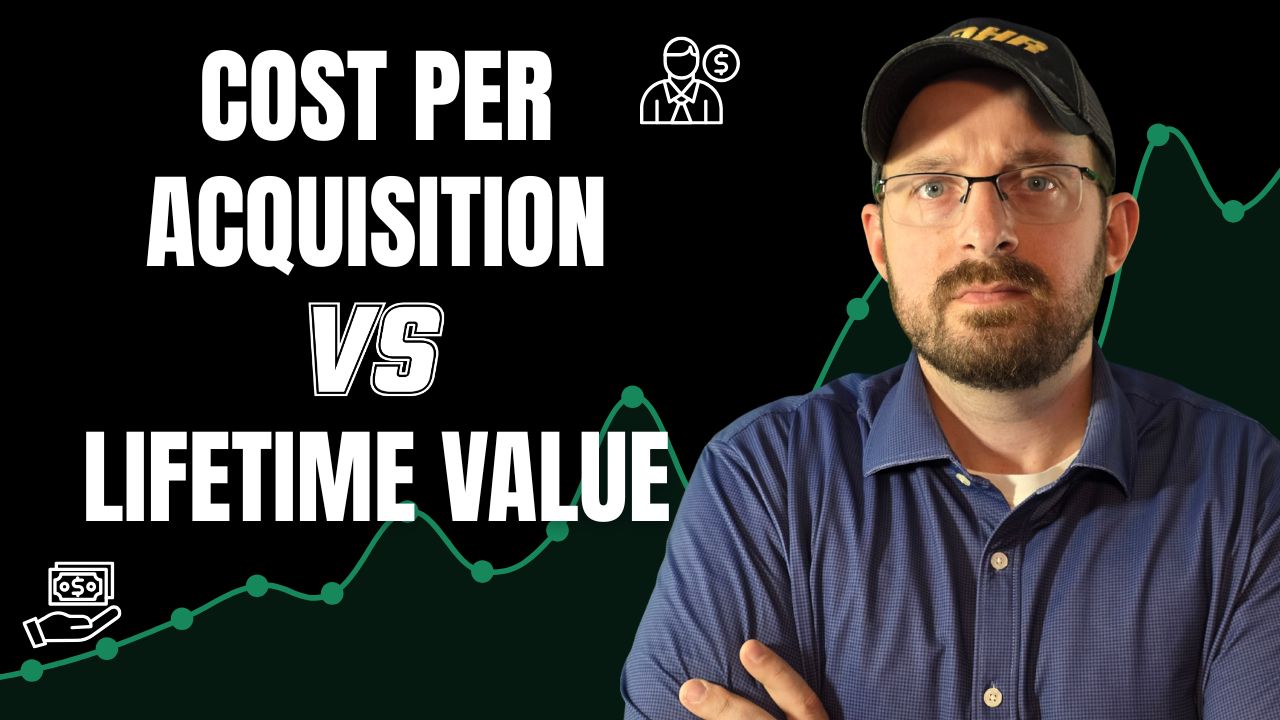
Every business runs on one equation, whether the owner knows it or not.
How much it costs to get a customer
versus
how much that customer is worth over time
Everything else is noise.
Most businesses struggle because they obsess over the wrong side of the equation. They fixate on lowering ad costs, chasing cheaper clicks, or squeezing platforms harder, while ignoring the number that actually determines whether growth is possible.
Lifetime value.
Cost Per Acquisition Is a Tool, Not the Goal
Cost Per Acquisition (CPA) is the amount of money spent to get one customer. Ads, software, labor, funnels, content, follow-up, all of it rolls into that number.
CPA matters, but it is not the enemy.
A high CPA does not mean a failing business. A low CPA does not mean a healthy one. CPA only has meaning when it is compared to what the customer produces after they enter your ecosystem.
A business that spends $75 to acquire a customer who spends $600 over the next year is winning aggressively.
A business that spends $15 to acquire a customer who spends $20 once is trapped.
Lifetime Value Is the Constraint That Matters
Lifetime Value (LTV) is how much money a customer produces over a defined period of time. The mistake most people make is guessing this number instead of calculating it.
Lifetime value is not optimism. It is math.
If a customer joins, buys once, leaves, and never returns, the lifetime value is whatever they paid that day.
If a customer joins, upgrades, buys add-ons, renews, and stays for months, the lifetime value compounds.
This number determines how much pressure your business can handle.
High lifetime value creates margin for mistakes, testing, and scale.
Low lifetime value forces perfection and fear.
The Rule That Never Breaks
Any business can scale if its cost per acquisition is lower than its lifetime value.
That is it.
Industry does not matter. Platform does not matter. Tactics do not matter.
When CPA is lower than LTV, you can buy growth. When CPA is higher than LTV, every new customer digs the hole deeper.
Why 30-Day Cash Collected Matters
There is a practical layer most people miss.
Cash timing.
Lifetime value over twelve months is useful, but businesses operate on cash flow. If the money comes in slowly while acquisition costs hit immediately, the math still breaks.
This is why 30-day cash collected matters.
If the cash collected in the first 30 days covers acquisition costs, the business can scale without starving itself. Credit cards, payment plans, and ad spend all live inside this window.
The goal is not theoretical profitability. The goal is survival while scaling.
Acquisition Becomes Easier When Ascension Exists
Businesses that struggle with CPA often blame ads. The real problem is the lack of ascension.
If the only thing a customer can buy is the entry offer, the business is capped. CPA becomes fragile. Growth slows the moment ads get slightly more expensive.
When customers can move forward, upgrade, join, renew, or deepen the relationship, acquisition becomes flexible.
Higher CPA becomes acceptable because the back end absorbs it.
This is how businesses survive ad fluctuations, platform changes, and market shifts.
The Hidden Danger of Cheap Leads
Cheap leads feel good. They create activity. They produce numbers.
They also create false confidence.
Cheap leads who never ascend destroy lifetime value. They consume attention, support, and time without producing revenue. They inflate lists and deflate profit.
A smaller number of higher-intent customers with strong lifetime value beats volume every time.
The Discipline That Changes Everything
The discipline is simple and ruthless.
Know the exact cost to acquire a customer.
Know the exact cash collected in the first 30 days.
Know the realistic lifetime value over time.
Then build offers, funnels, and follow-up that expand LTV instead of chasing cheaper CPA.
Businesses do not fail because ads stop working.
They fail because the math stops working.
When the math is right, scale becomes boring, predictable, and controllable.
Cost Per Acquisition is the price of entry.
Lifetime Value is the engine.
One without the other is just motion without progress.














Leave a Reply